 Overtone
Get Overtone
How to improve your intonation on the violin
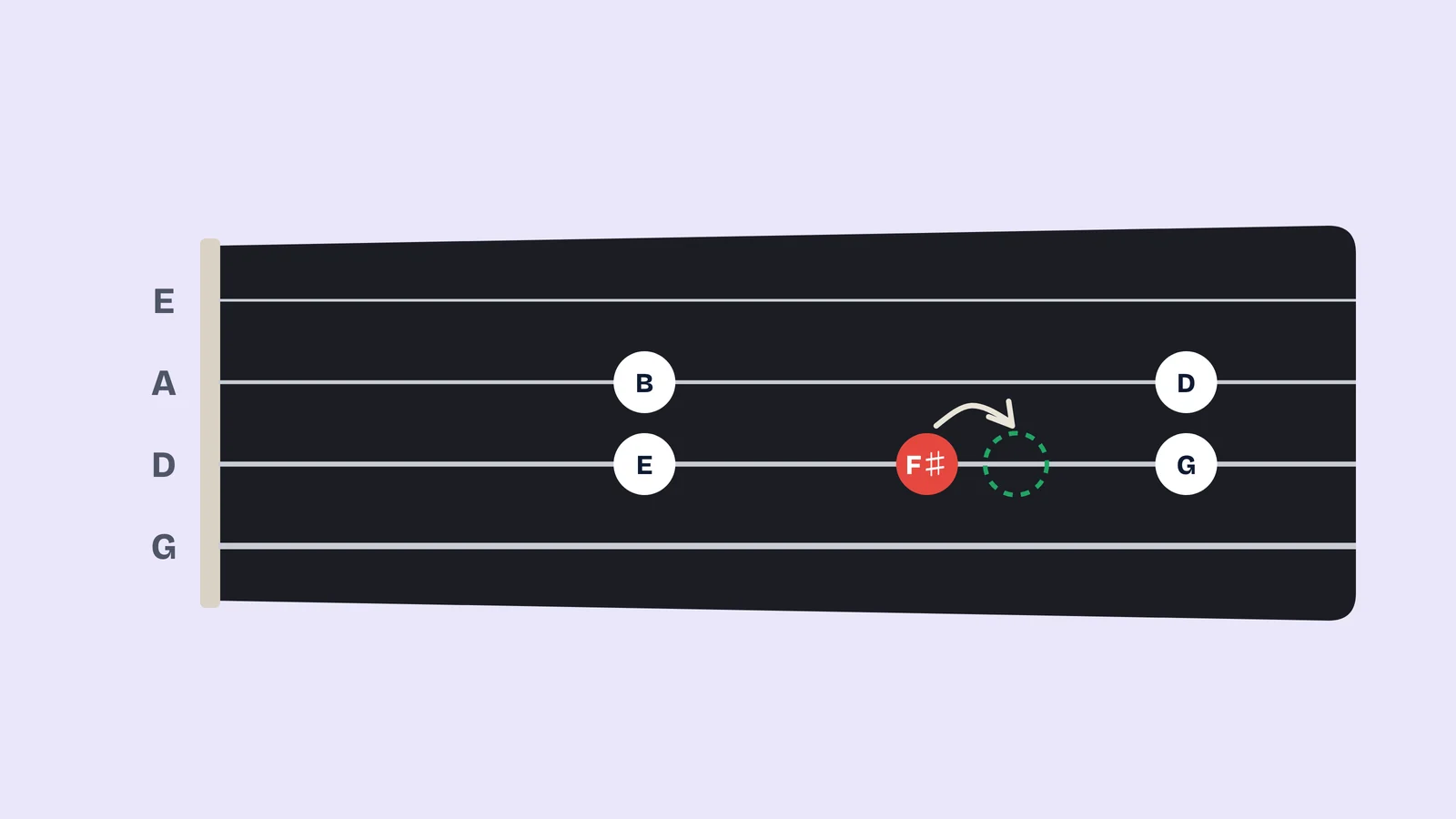
To improve your intonation on the violin, practice slowly and check your notes against pitches that can’t drift, like your open strings or a drone. When a note is off, fix it, then play it again from the note before so your finger learns where to land. Here are the checks the violin gives you for free, and a slow routine built on them.
Why violin intonation slips
With no frets, every note is your finger’s best guess. In first position, moving a finger about 2 millimeters changes the pitch by 10 cents, enough to hear next to a piano. When the thumb creeps or a shift lands short, every finger after it is off too.
Your ear also adapts: play a flat F♯ every day for a week and it starts to sound normal, so run-throughs alone won’t fix it. You need something outside your hand to check against.
Set a frame for your hand
Place the fingers as a frame: the first and fourth a perfect fourth apart, the middle two inside it. On the A string in first position, that’s B and E. The fourth-finger E should match the open E string exactly. If the two beat when you play them together, fix the frame first.
The second finger moves with the key: low, close to the first finger, for C natural on the A string, and high, close to the third, for C♯.
Let the open strings check you
When you play a G, D, A or E in tune, the open string of that name rings along with it, even an octave away. The note blooms and carries on after the bow stops. A few cents off and the ring is gone.
In first position, the third finger on the D, A and E strings and the fourth finger on the lower three all make ring tones. Use them as checkpoints: if they ring, the fingers around them are usually close. F♯ and C♯ have no open string to ring with, so they wander the most. Check them against a neighbor: on the D string, play F♯, G, F♯ and keep that half step small.
A slow routine for scales and pieces
- Pick the scale of your piece’s key. For a piece in G major, two octaves up from the open G string.
- Slow it right down. Set the metronome to 60 and give each note two beats (more in our guide to practicing with a metronome).
- Stop on anything doubtful. Check it against a ring tone or the drone, and move the finger until it rings.
- Play it again from the note before. It’s the step people skip. Sliding into place teaches the slide, while replaying the two notes teaches the distance.
- Do the same with your piece. Four bars at a time, slower than feels necessary. Ten minutes a day is plenty.
Shifts get the same care: slide slowly on the old finger to its spot in the new position, then put the new finger down. A shift to third position on the A string puts the first finger on D, which rings with the open D.
Practicing violin intonation over a drone
A drone is a note held under your playing. Hold a G under a G major scale and every note either rubs against it or rings with it. A note a few cents off makes a slow wobble, called beating, which stops when your finger finds the spot.
The B that rings over a G drone, a major third, sits about 14 cents lower than the tuner’s B, so over a drone, trust the ring. See How to practice with a drone and What the cents on your tuner mean.
In Overtone
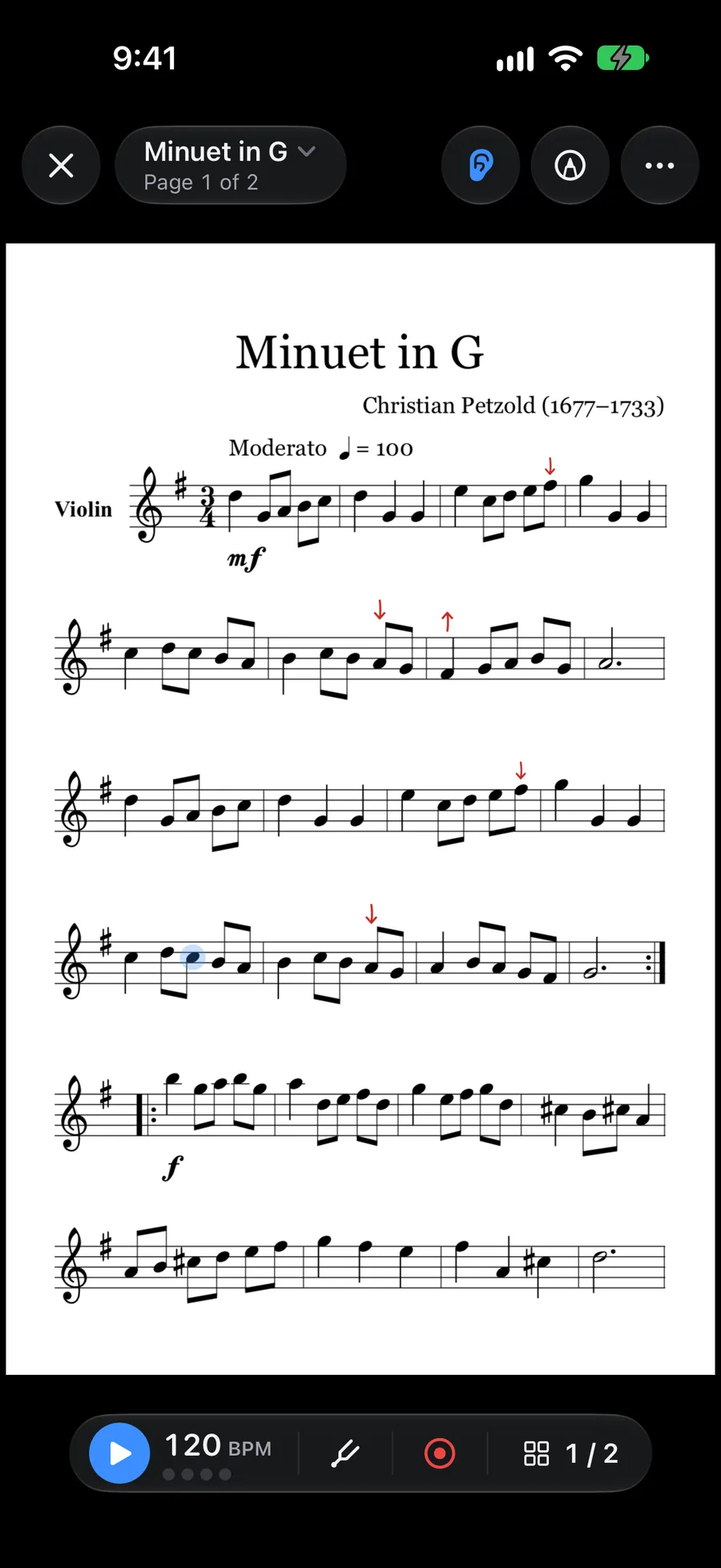
Open your piece in the reader and turn on Listen. Overtone follows the score and pencils a small red arrow over any note that keeps coming out too high or too low, pointing the way to move it. A single slip marks nothing, and once you’ve played the note in tune a few times, the arrow goes away. Each take’s report names what to work on, like “F♯4 ran 25¢ flat on average.”
The drone is in the Sound tab (its cello sound is easy to hear under a violin), and the tuner’s Open Strings mode tunes your strings.
Questions
Do finger tapes help with violin intonation?
They help beginners find first position and see where a low or high second finger goes. But they train your eyes, and a finger on the tape can still be several cents out, so take them off one at a time once your frame feels steady.
How long does it take to play the violin in tune?
Most students hear a clear difference after a few weeks of slow scales over a drone, and first position settles well before the higher ones. Even professionals keep checking, because the hand and the ear drift a little every day.